
Repunched Mint Marks: What You Are Actually Looking At
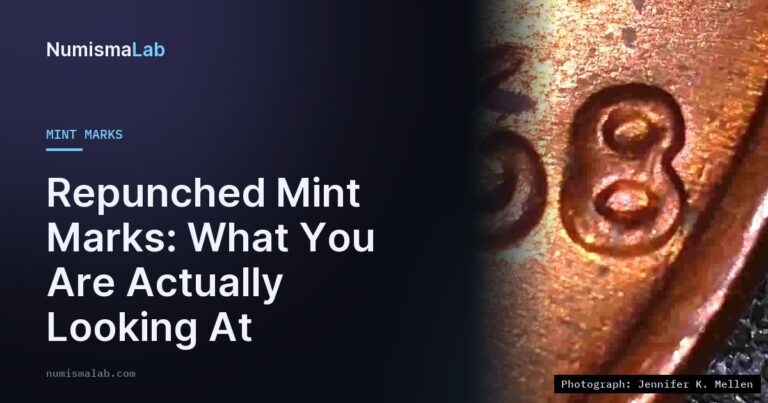
Here is the fact that makes repunched mint marks possible, and it surprises people: until 1990
for cents, the mint mark was not part of the design. It was punched into each working die
individually, by a person, with a hand punch and a hammer.
A person doing that thousands of times is going to hit one twice.
What a repunch actually is
The punch goes in, the impression is not deep enough or not quite straight, so it gets struck
again – slightly offset, slightly rotated, or at a different angle. Both impressions are now cut into
the die, and every coin struck from that die carries both.
The secondary is raised metal at full height, because it was cut into the die the same
way the primary was. That is the signature. It is not a shadow and it is not a smear.
Once mint marks moved onto the master hub around 1990, this stopped being possible. Which is why
RPM hunting is a pre-1990 activity, and why the good ones are finite – no more are being made.
The vocabulary, briefly
- RPM – repunched mint mark. Same letter, punched more than once.
- OMM – over mint mark. A D over an S, or an S over a D. Rarer and generally worth
more, because a die intended for one mint was repurposed. - D/D North, D/D South and so on – where the secondary sits relative to the
primary. That is how they are catalogued and how you describe one to somebody else.
What it is not, and this is where the money goes
Three things look like a repunched mint mark and are not:
Machine doubling. The die bounced at the strike and dragged across metal already
formed. The result is a flat shelf, lower than the original relief, often shiny where it scraped. It
is on this coin and not on the die, and it is worth nothing. This accounts for most of what gets
posted as an RPM.
A filled or worn mint mark. Grease and metal fill the recess in the die, so the
letter strikes soft and mushy with a vague outline that reads as a shadow at low magnification. It
is an absence of detail, not extra metal.
Plating blisters and corrosion. On copper-plated zinc cents, 1982 onward, the
plating lifts in blisters that can sit right next to a letter. Raised, yes – but raised plating
rather than struck metal.
How you actually tell
Move the lamp. Every time, on this site, the answer is the same because the question is the same
one. A repunched mint mark is raised metal: bright on the side facing the light, shadowed away from
it. Machine doubling is a shelf that catches light along its flat and looks wrong from the other
side. A groove is bright on the side away from the lamp entirely.
Two frames, lamp on opposite sides, nothing else moved. That single habit resolves most of these
arguments without any software at all.
Then get the number
CONECA numbers RPMs in the form 1-O-IV: die 1, obverse, class IV. VarietyVista and Wexler both
publish listings with photographs and, crucially, die markers – the scratches and gouges
that identify that specific die.
The markers are what settle an attribution. Two RPMs of the same date can look almost identical in
the mint mark and be told apart instantly by a die scratch three letters away. When somebody argues
about whether a coin is 1-O-IV or 5-O-V, that is what decides it.
Where to start looking
The wheat cents, the early Memorial cents, the Jefferson nickels of the forties and fifties. Any
branch mint issue before 1990. The 1940s and 1950s cents are thick with listed RPMs precisely
because that is when the most dies were being hand-punched at the highest volume.
And look at the coins you already have before buying more. Most people’s first find is in a
tube they have owned for years.
The coin reference has the mint mark styles by series — measure it, see the working, and get a refusal when the evidence will not carry the question.
Not the tool for your problem? GenM Software makes others.
