
Machine Doubling vs Hub Doubling: Let Them Argue It Out
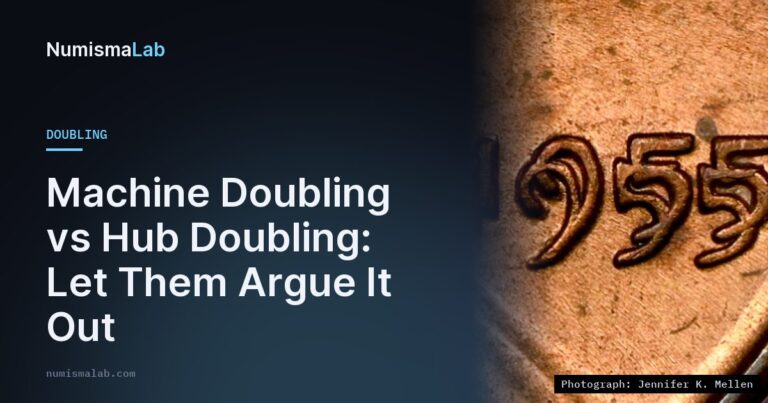
Every week somebody posts a photo of a doubled letter and asks what it is. Every week the same
fight breaks out in the replies. So instead of refereeing it again, I am going to let both sides make
their case, and then I will tell you how to settle it yourself.
Two claimants. One coin. The letters on it are doubled, and only one of these is worth money.
Round one: opening statements
HUB DOUBLING: I happened before the coin existed. When the die was made, the hub
came down on it more than once, and the second impression landed slightly off from the first. That
misalignment got cut into the die as shape. Every coin struck from that die carries me. There
are only so many coins from one die, and collectors pay for that.
MACHINE DOUBLING: I happened in the last thousandth of a second. The die was
already finished and correct. At the moment of the strike it shifted – bounced, twisted, slipped in
the collar – and dragged across metal that had already been formed. I am not on the die. I am on
this coin, and maybe the next forty, and then the press gets serviced and I stop.
HUB DOUBLING: Which is why he is worth nothing.
MACHINE DOUBLING: Which is why I am honest about what I am, unlike people who
sell me as you.
Round two: what you actually look like
HUB DOUBLING: My secondary image is full height. It stands up off the
field the same way the primary does, because it was cut into the die at full depth. Rounded top. Real
metal. Look at a serif on one of my letters and you will often see a notch – a little step at the
corner where the two impressions did not line up. Sometimes a clean separation line between the two
images, both of them properly raised.
MACHINE DOUBLING: Mine is a shelf. Flat. Lower than the original relief, because
I did not add metal, I smeared what was already there. Look at me in cross-section and you get one
proper crest and then a flat ledge beside it, like a step. I am subtractive. I eat detail rather than
duplicating it.
HUB DOUBLING: He looks shiny and flat and slightly scraped.
MACHINE DOUBLING: I do. Because that is what I am.
Round three: where you show up on the coin
MACHINE DOUBLING: Same direction, everywhere, usually. The whole die moved as one
piece, so I am consistent across the coin, and typically strongest where the relief was tallest,
since that is what caught the drag.
HUB DOUBLING: Depends which class I am, and this is where people go wrong. If I
am Class I – rotated – the secondary image is turned around the center of the coin, so my spread gets
wider the further out you go. Barely anything in the middle. Obvious at the rim lettering. If
I am Class V, pivoted, I am strong on one side and fade toward a pivot point somewhere else
entirely.
On the 1972 cents, fourteen of the listed varieties are Class I. That widening-from-center pattern
is the thing to check, and it is a pattern you can only see by looking at the whole coin, not
at one letter.
MACHINE DOUBLING: He is right, annoyingly. I do not do patterns across a coin. I
do one push.
Round four: the argument neither of you can win from a photograph
Here is where I have to stop them both.
Everything above is true and none of it is reliable from a single picture. A shelf lit from one
side and a raised secondary image lit from the other side can look identical. You are not looking at
shape in a photograph. You are looking at brightness, and brightness is the lamp’s opinion as much as
the coin’s.
The failure mode is worse than being unsure. It is being confidently wrong, because one
photograph under one light is exactly as convincing when it is misleading as when it is not.
There is a spacing problem on top of that. When the two crests sit about one stroke-width apart,
an ordinary letter and a genuine second impression produce nearly the same brightness profile. I
tested this repeatedly while building the doubling tools and it would not separate. That is not a
tuning problem a better threshold fixes. There is no information there to separate.
So the honest answer at that spacing is “I cannot tell from this”, and any tool that hands you a
verdict instead is guessing on your behalf.
How you actually settle it
Move the lamp. That is it. That is the whole test.
Raised metal is bright on the side facing the light and shadowed on the side away from it. A
groove or a flattened shelf does the opposite, because the lamp lights its far wall. So shoot
the same framing twice – lamp left, then lamp right, nothing else moved – and watch what the feature
does.
If the bright side follows the lamp, you are looking at something standing up. If it does the
reverse, you are looking at something scraped or sunk.
One photo cannot show you that. Two photos from opposite sides cannot be argued with.
Four is better: left, right, top, bottom. I ran a set recently where the lamp only moved 47
degrees between frames and the test refused to give me an answer – correctly, because 47 degrees is
not opposite sides, it is the same side twice. The refusal was right and I was the one who set it up
badly.
Then look at the whole coin, and then find the markers
If the spread widens toward the rim and leans the same rotational direction all the way round,
that is consistent with a rotated hub. If it is strong on one letter and gone two letters over, that
is a local event – a bounce.
Then find the die markers. This is the step nobody talks about and the one that ends arguments.
The listed varieties carry scratches, gouges and chips that identify a specific die. The 1972
cents have 153 listed die scratches and 91 gouges between them. Doubling tells you something
happened; the markers tell you which die you are holding. When two people disagree about
whether a coin is DDO-001 or DDO-003, it is the markers that decide, never the doubling.
Closing statements
MACHINE DOUBLING: I am common, I am worth nothing, and about eight in ten of the
coins people bring to this argument are me. I would rather you knew that up front.
HUB DOUBLING: And I am rarer than the internet suggests, which is why people talk
themselves into seeing me. If you want me, prove me – with the lamp moved, with the whole coin in
frame, and with a marker that matches.
Fair enough. Both of you can go.
CoinScope Pro is built around that middle section, the part where neither side wins from a
photograph. It measures the reversal when the lamp moves, it fits one transform to the whole coin
instead of judging a single letter, and when the two crests sit too close to separate it says so
instead of picking a side.
See what it measures — measure it, see the working, and get a refusal when the evidence will not carry the question.
Not the tool for your problem? GenM Software makes others.
