
Fill the Frame: Why a Wide Shot Answers About Your Table
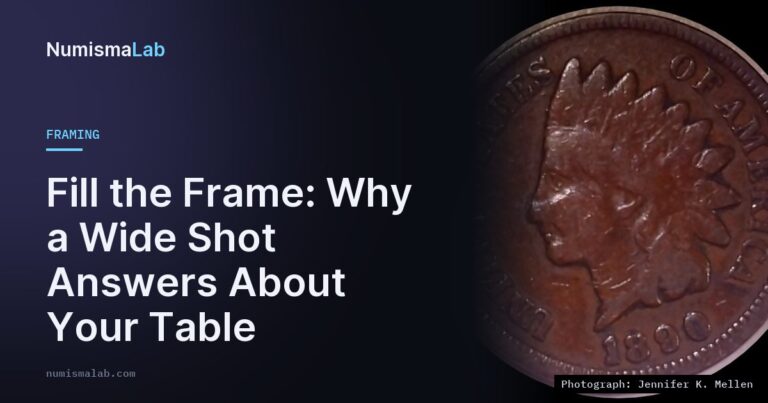
I noticed this before I could explain it. Measurements taken with the coin filling the frame came
back consistent and sensible. The same tools, on the same coin, shot from further back with the mat
visible around it, came back muddier – not obviously wrong, just less reliable, and harder to
reproduce. It took sitting down with the numbers to work out why, and the reason is embarrassingly
simple once you see it.
The software measures the whole picture
A surface texture tool does not know which pixels are coin. It computes across everything it is
given. If the coin is a third of the frame, then two thirds of every average, every threshold and
every distribution is describing something that is not the coin.
That would be tolerable if the background were blank. It is not. Under a microscope lamp, a
typical dark mat is a dense field of high-contrast speckle – thousands of tiny bright points and hard
shadows. To a texture measurement, that reads as extremely rough surface. So the tool dutifully
averages your coin’s smooth fields together with a surface far rougher than anything on the coin, and
hands back a figure that is partly about your coin and largely about your desk.
Where the line is, roughly
I put a number on it when I built the warning into the program: if the detected coin covers less
than about a fifth of the frame, more than three quarters of what any texture tool averages over is
not the coin. At that point it is not a small bias. The tool is answering a different question from
the one you asked.
Above about half the frame, it stops mattering much. Between those, it depends on how dark and
how uniform your background is – which is itself an argument for a plain, non-sparkly mat.
The photography habit that transfers
Photographers already know this instinct, we just learned it for a different reason. You fill the
frame with the subject because anything else in the frame competes for attention. In coin work the
competition is not for the viewer’s eye, it is for the measurement’s average – but the fix is
identical, and if you have ever shot anything seriously you already have the reflex.
The rule generalizes further than “get closer to the coin”. Frame the thing you are asking about.
If the question is about one letter, fill the frame with that letter. If the question is about the
whole coin’s surface, let the coin reach the edges. A tight crop on the date tells you about the
date; a full-coin shot tells you about the coin. Neither substitutes for the other, and the mistake
is to shoot one and ask the other’s question.
What you lose by cropping in software instead
Cropping afterward is better than nothing, and it is not the same thing. When you crop, you keep
the pixels you already captured – so a coin that occupied a fifth of the frame still only has a
fifth of the frame’s resolution, and cropping to it just makes those few pixels larger. Moving the
scope closer captures the coin with the sensor’s full resolution. Fine surface detail lives or dies
on that difference.
There is one exception worth knowing. If you are shooting a series to compare against each other,
consistency beats absolute tightness. A set of shots framed identically at a slightly wider setting
is more useful than a set where you crept closer each time, because the comparison is the point.
A note on what a tight frame costs you
Fill the frame with one letter and the software can no longer find the whole coin – which means it
cannot anchor a scale to the rim, and it cannot give features a position on the coin. In CoinScope Pro
the die crack map notices this and says so: the grid falls back to the frame, and the report states
outright that those positions will not match another shot at another zoom.
So the working answer is to shoot both. A straight-on whole-coin frame anchors everything and
gives you the scale. Then close frames on whatever you found. The whole-coin shot is the map; the
close shots are the evidence.
The habit worth building
Before you run any tool, look at what is in the frame and ask what fraction of it you actually
care about. If the answer is “less than half”, move the scope before you measure. It costs ten
seconds and it is the single cheapest improvement available to most people’s results.
CoinScope Pro now warns you when your coin is a small part of the frame, because a confident
number about your desk is worse than no number at all. It also tells you when it cannot
anchor to the coin, rather than pretending the position it gives you will travel.
Try it on your own photographs.
